CHICAGO — Walk into a laundromat and what do you notice first? The brightness of the lighting. Whether the floors are clean. The smell. Whether anyone behind the counter looks up. Long before a single machine runs, a customer has already formed an impression — and that impression is your brand.
This is the reality of branding touchpoints. They’re the sum of every encounter a customer has with your business, from a 2 a.m. Google search to a Thursday afternoon drop-off, from a reply to a one-star review to the font on your loyalty card.
And for the neighborhood laundry business where the same faces come through the door week after week, those touchpoints aren’t incidental. They’re the business.
American Coin-Op contacted a trio of marketing professionals who work closely with laundry operators and asked them to share what branding touchpoints really mean, why they matter more than most owners realize, and what practical steps operators can take right now to strengthen every link in their chain.
In Part 1, they defined “touchpoint” and emphasized repeat customers as the stakes for branding a business the right way. Let’s continue:
Customer Service as Brand Proof
There is a significant gap, in virtually every service industry, between a brand’s stated promise and its delivered reality. That gap is most visible — and most consequential — at the level of customer service. For laundry operators, every interaction is a chance to close that gap or widen it.
“Customer service is what proves your brand promise is real,” says Charles Measley, co-founder of Suds Digital, a marketing agency based in Eatontown, New Jersey, that works specifically with laundry businesses. “You can say you’re clean, fast, and reliable, but it’s how you treat customers that either backs that up or completely kills it.”
Dennis Diaz, president of the New York City-based digital marketing agency Spynr, describes a personal experience that illustrates the point. He walked into a restaurant that looked excellent from the outside — strong signage, clean design — but the moment he stepped inside, the energy dropped.
“The staff seemed disengaged, and the experience just felt flat,” he recalls. “The food was OK, but the service made it worse. People will forgive a lot if you treat them well. But if the service is off, it amplifies everything else in a negative way.”
Brett Lyon, president of LaundroBoost Marketing, a Cincinnati, Ohio-based firm focused on digital marketing for the laundry industry, pushes this further into the digital realm, where the stakes of customer service have multiplied in ways many operators have not yet internalized.
Every Google review response is a public act of customer service, visible to every potential customer who reads it. How a business handles a complaint — not just in person, but online — is now as important a brand signal as the quality of its machines.
“The businesses that win are the ones that see complaints — online and offline — as opportunities,” Lyon says. “A customer who has a problem that gets resolved quickly and generously often becomes more loyal than one who never had an issue. And when you resolve that issue publicly in a Google review response? You’ve just shown every potential customer how you handle problems.”
The Physical Space Speaks First
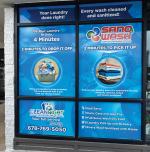
Before a word is spoken or a machine loaded, a laundromat’s physical environment is already broadcasting. Lighting, cleanliness, layout, signage and smell represent communication. And for the modern laundry operator, they are also marketing assets.
Lyon makes an argument that few operators have heard: Your physical space is your most powerful digital marketing asset.
The photos that appear on your Google Business Profile, in your Facebook ads, and on your website homepage are photographs of your store. To invest in the physical environment is to invest in your digital marketing performance.
“Bright, well-lit spaces feel safer, more professional, and photograph better for your marketing,” Lyon notes. “Cleanliness isn’t just for customers in-store; it’s for the photos that will represent you online for months.
“Smart operators think about their physical space with digital marketing in mind. They ask: How will this look in photos? On our website? In an ad? Because in 2026, your physical space doesn’t just serve walk-in customers — it serves as the backdrop for all your digital marketing.”
Diaz describes what he calls the “vibe check”: the immediate, unconscious assessment every customer makes when entering a space.
“Do people feel safe? Is it clean? Is it easy to understand where to go and what to do?” he says. “The layout should guide people naturally, the signage should remove confusion, and the cleanliness should show pride. When those things are dialed in, customers don’t just use your business — they enjoy being there.”
In Part 3 coming May 19: The digital touchpoint hierarchy, and your online reputation as revenue driver
Miss Part 1? You can read it HERE

Have a question or comment? E-mail our editor Bruce Beggs at [email protected].