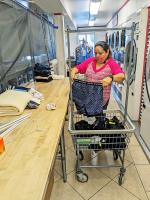
CHICAGO — For self-service laundry owners, offering wash-dry-fold (WDF) service often marks the first step toward expanding beyond their four walls. It’s a natural evolution — customers drop off their laundry; attendants wash, dry, and neatly package it for pickup; and the business collects a premium price per pound.
But the logical question arises: Should I add pickup and delivery?
On the surface, it’s easy to be tempted. Pickup and delivery has been one of the most talked-about growth opportunities for nearly a decade. It can open your business to new, convenience-driven customers while boosting equipment turns and generating revenue at hours when your machines would otherwise sit idle. Yet, it’s a fundamentally different business model that adds layers of logistics, staffing, software, marketing, and customer service demands.
Two veteran operators — Paul Hansen, a retired multi-store owner turned consultant for Mr. Sudsy Consulting and Coaching, and Dave Menz, owner of four Queen City Laundry locations in Cincinnati — shared their real-world lessons about what it takes to make pickup and delivery work. Their experiences offer valuable insights for any laundry owner considering the leap.
WHY PICKUP AND DELIVERY APPEALS TO LAUNDROMAT OWNERS
Both Hansen and Menz were driven by the same realization: their stores weren’t fully utilizing their expensive equipment.
“I had all this big, beautiful, expensive equipment that was sitting from 12 p.m. till 5 a.m. just dormant,” Hansen recalls of his Chicago stores. “I figured, let’s try and get these things doing something.” He already had staff in place for his 24-hour stores, so the idea of using that “dead time” for off-hour production seemed logical.
Menz had a similar motivation but framed it around optimizing his debt-heavy business.
“After five years, I realized I was doing OK, but I wasn’t really optimizing my facilities,” he says. “A washer is being used maybe two hours a day. What about the other 22 hours? I’d bought a lot of equipment, I had a lot of debt, and I wanted to fully utilize those facilities.”
Pickup and delivery also fit a broader shift in consumer habits. Menz saw it as part of the rise of the service economy — “from people who no longer cut their own grass or change their own oil” to customers now willing to outsource laundry.
Hansen noticed the same consumer mindset emerging even before the COVID-19 pandemic: “People were getting used to ordering everyday things from their home,” he says. “I figured laundry might be something they’d be interested in, too.”
THE FIRST STEPS: START SMALL AND TEST THE MARKET
Both operators caution against launching too broadly. Hansen started by processing orders at a single location and using existing vehicles from his free shuttle service before investing in new vans. “We always had one central store that was our processing hub,” he explains. “We’d start small and expand as we retooled other stores.”
Menz, too, began with one centrally located laundromat — his largest at the time — and avoided spreading operations across multiple sites until his system was refined. “If I fragmented it into three or four locations, every problem I had, I’d have to solve three or four times,” he says. “By keeping it in one place, I could focus on perfecting the process first.”
Neither man performed extensive market research before launching.
“We didn’t really,” Hansen admits. “It was more of a hunch, based on seeing trends like Uber and DoorDash.”
Menz had a similar faith-based leap: “The truth is, I didn’t analyze the market much. I just believed laundry-to-your-door was something people would want if they understood it.”
For many laundry owners, that “proof of concept” phase — testing logistics, ironing out production, and gauging demand — is more valuable than a formal market study. Still, both men stress the importance of controlling costs and keeping early ambitions in check.
“It’s OK to start small,” Menz says. “If I could go back, I’d have launched with maybe a third of the territory I did. I tried to serve nearly the entire metro area and ended up losing money on every pound of laundry. I should have focused on the low-hanging fruit — (within) 10 to 15 minutes around my stores — and grown outward from there.”
INVESTMENT AND INFRASTRUCTURE: WHAT IT TAKES TO LAUNCH
Adding pickup and delivery requires more than just a van. Hansen’s initial costs included software subscriptions and bulk detergents. “Once it started to pick up, I bought a big cargo van,” he says. “We also had to buy higher-quality detergents in bulk and start staffing up.”
He repurposed his existing staff at first but eventually grew to as many as 12 employees working overnight to handle orders. That included a manager who coordinated logistics and hiring.
Menz’s experience mirrored that scaling curve. His early investments included pickup and delivery software and a professionally wrapped van. “The software only cost a few hundred bucks a month, but it was one of the best decisions we made,” he says. “Even when we didn’t need it yet, it gave us structure and made us look professional to customers.”
Marketing, however, was where Menz saw many owners underestimate the commitment. “Plan to invest a few thousand dollars a month in marketing,” he advises. “You’re going to lose money at first — it can take 12 to 18 months before your customer acquisition costs pay off. But the long-term customer lifetime value makes it worth it.”
OPERATIONS AND LOGISTICS: A DIFFERENT ANIMAL
“Pickup and delivery is a whole different animal (than WDF),” Hansen says. “You’ve got control within your store walls, but once that truck leaves, your control goes with it.” The logistics — route scheduling, driver reliability, vehicle maintenance, and communication — can make or break your reputation.
Menz agrees, emphasizing redundancies and reliability. “From day one, I told my team: if we don’t make money, that’s OK — we’ll fix that. But we’re never going to let the customer down,” he says. “If we say we’ll be there between 2 and 3, we’ll be there. If a truck breaks down, we rent one. If someone gets sick, someone else is trained to cover.”
Hansen’s second attempt at pickup and delivery succeeded largely because he implemented operational software from Starchup and created a written manual that documented every step of his process — from receiving to packaging.
STAFFING AND LABOR ECONOMICS
Labor is where both men learned hard lessons. Hansen started by using existing night staff, but the service quickly demanded more people.
“We went from one or two night attendants to eight or 10 people,” he says. “At one point, it got expensive, especially when drivers didn’t show up. We’d have a full team waiting around and no laundry to process.”
Early on, Menz didn’t grasp how crucial productivity tracking was. “We had people processing laundry at 13-15 pounds an hour,” he recalls. “That’s atrocious. We were losing money on every pound.”
Over time, he developed strict team accountability standards: 30 pounds per hour minimum, with top performers doubling that.
“It took us years and a few hundred thousand dollars in losses to figure out our labor economics,” Menz says candidly. “Now we maintain a 30–35% margin, but it took years of losing money to get there.”
Check back Tuesday for the conclusion!

Contributors to This Article


Have a question or comment? E-mail our editor Bruce Beggs at [email protected].