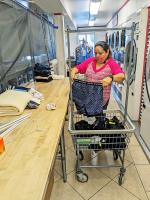
CHICAGO — For self-service laundry owners, offering wash-dry-fold (WDF) service often marks the first step toward expanding beyond their four walls. It’s a natural evolution — customers drop off their laundry; attendants wash, dry, and neatly package it for pickup; and the business collects a premium price per pound.
But the logical question arises: Should I add pickup and delivery?
On the surface, it’s easy to be tempted. It can open your business to new, convenience-driven customers while boosting equipment turns and generating revenue at hours when your machines would otherwise sit idle. Yet, it’s a fundamentally different business model that adds layers of logistics, staffing, software, marketing, and customer service demands.
Two veteran operators — Paul Hansen, a retired multi-store owner turned consultant for Mr. Sudsy Consulting and Coaching, and Dave Menz, owner of four Queen City Laundry locations in Cincinnati — shared their real-world lessons about what it takes to make pickup and delivery work.
In Part 1, we shared their insights on several aspects of providing pickup and delivery service. Let’s conclude today with some more:
CUSTOMER EXPECTATIONS: PREMIUM SERVICE, PREMIUM STANDARDS
Pickup and delivery customers are often willing to pay more, but they also expect more.
“They’re paying a premium, so of course they have higher expectations,” says Menz. “We welcome that because we position it as a ‘good, better, best’ model — self-serve, drop-off, then pickup and delivery.”
Customization is key. His team uses software that records each customer’s preferences: temperature, detergent brand, folding style, softener use, and more. “We’ll do your laundry the way you do it,” he says. “It’s hard to execute at scale, but that’s what differentiates us.”
Hansen found the same need for consistency and quality. His staff studied packaging and presentation techniques from other successful operators, focusing on uniformity.
MARKETING AND CUSTOMER ACQUISITION
Acquiring pickup and delivery customers takes time and money.
Hansen relied mainly on Google and Facebook ads, as well as branded vehicles, for visibility.
Menz, who also partners in a marketing firm called LaundroBoost, encourages owners to think long-term and measure performance carefully. Depending on your service area, you’ll probably acquire 10 to 20 customers a month but half won’t every schedule a pickup. A few will use you short-term, and maybe 20-25% will become recurring. That 20% is where your profit comes from.
COMMON PITFALLS AND LESSONS LEARNED
Both men’s first attempts at pickup and delivery stumbled. Hansen’s early pricing was too low, his routes inefficient, and his logistics chaotic. “My partner would drive 25 miles to pick up a $10 bag,” he says. “It just didn’t make sense.”
Menz’s problem was the opposite — he grew too fast and lacked the operational discipline at the time to support it. His wife Carla warned him he was growing the business “into bankruptcy.”
In both cases, the turning point came from systematizing: tracking costs per pound, establishing route density, setting clear productivity goals, and refining pricing models.
“If you’re selling watermelons and you lose a quarter on every one,” Menz quips, “the last thing you want to do is buy a bigger truck.”
ADVICE FOR FIRST-TIME PICKUP AND DELIVERY OPERATORS
Both veterans emphasize preparation, patience and perspective.
“Make sure you have the time and bandwidth to do it,” Hansen advises. Check every box — storage, staffing, logistics and timing — before launching. And don’t think of it as a side gig, because it’s a separate business that requires real management.
Menz echoes that sentiment. “Play the long game,” he says. “You’re probably not going to make money for a year or two. That’s OK — if you stick with it and keep improving, you’ll get there.”
FINAL THOUGHTS: THE RIGHT REASONS TO EXPAND
For Hansen and Menz, pickup and delivery ultimately became a lesson in discipline, systems and customer experience.
“It can absolutely transform your business,” Menz says. “But it’s not easy, and it’s not fast.”
If you treat it like a long-term investment, it could double your business. If you treat it like a quick side hustle, it’ll probably fail.
Hansen agrees, adding that success comes from humility and continuous learning. “One thing I’ve learned is that I don’t know everything,” he says. “That’s why I stay involved in the industry. There’s always something new to learn.”
For laundromat owners eyeing the road ahead, that may be the most valuable takeaway of all: adding pickup and delivery can make sense — but only if you’re prepared to do it the right way, for the right reasons, and with a long-term mindset.
If you missed Part 1, you can read it HERE.
Contributors to This Article


Have a question or comment? E-mail our editor Bruce Beggs at [email protected].