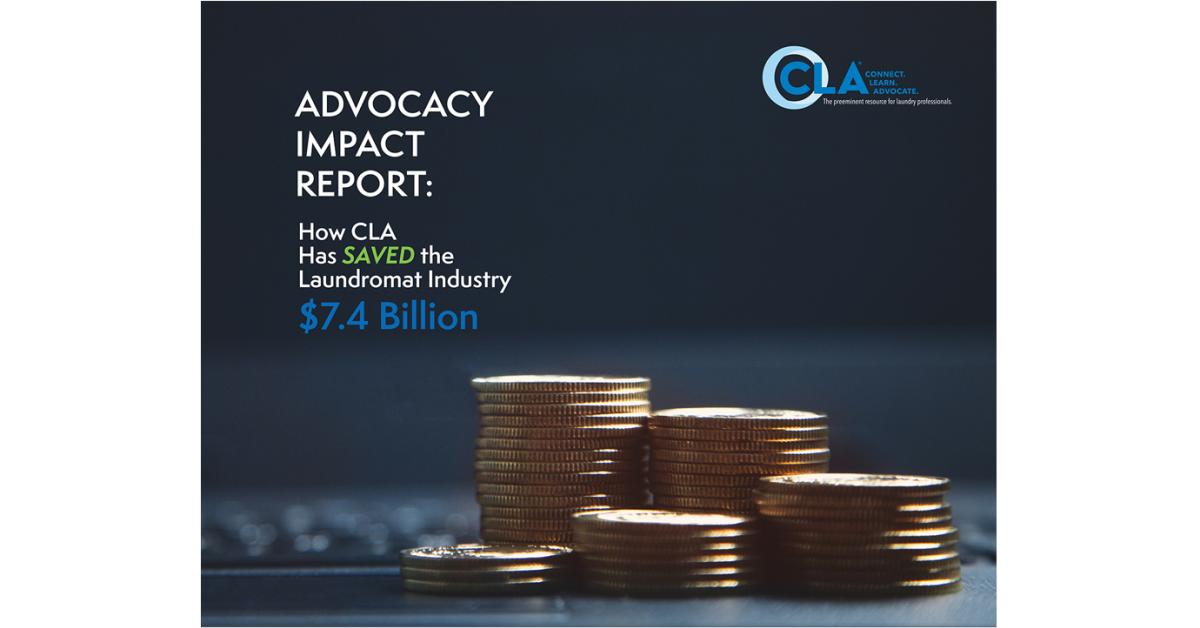
OAKBROOK TERRACE, Ill. — CLA (formerly the Coin Laundry Association) recently released its 2026 Advocacy Impact Report, a comprehensive look at how the association’s legislative and regulatory work delivered an estimated $7.4 billion in savings to the laundromat industry over the past 20 years.
It explains that advocacy has been central to CLA’s mission since its founding in 1960. CLA works to educate lawmakers and regulators about the unique needs of laundromat owners and the communities they serve, emphasizing that proposed legislation can sometimes create unintended consequences for small businesses and lower-income households that depend on self-service laundry.
The report documents CLA’s “wins” across a range of high-stakes issues — from preserving sales tax exemptions for self-service laundry in 42 states, to securing the designation of laundromats as essential businesses during the COVID-19 pandemic, to beating back microfiber filtration mandates that would have proven operationally devastating for laundromat owners nationwide.
The $7.4 billion in total estimated savings breaks down across three primary areas:
- $2.4 billion from preserving sales tax exemptions
- $3.5 billion from securing the essential business designation during COVID-19 shutdowns
- $1.5 billion from other legislative and regulatory initiatives
For laundromat customers — identified by CLA as households averaging below $40,000 in annual income — every dollar saved through advocacy is a dollar that doesn’t get passed down at the laundry machine. For owners, it’s the difference between a viable business and one buried in compliance costs and tax burdens that were never meant to apply to them.
“CLA is proud to represent the best interests of the laundromat industry to legislators and regulators from coast to coast,” says Brian Wallace, CLA president and CEO. “Our members make valuable contributions to the communities they serve and CLA’s job is to share that message with decision-makers. This Advocacy Impact Report is a powerful accounting of what the strength in numbers among our members can achieve together.”
To support its legislative efforts, CLA partners with allied industry organizations and works with government relations specialists to monitor proposed laws and regulations. This networking allows the association to respond quickly to emerging threats and coordinate lobbying efforts across the country.
The report reflects two decades of coordinated work by CLA members, staff, and advocates pushing for policy outcomes that keep laundromats viable and accessible.
Future advocacy priorities identified in the report may include artificial intelligence (AI), data privacy, labor regulation, payment infrastructure and energy policy.
Have a question or comment? E-mail our editor Bruce Beggs at [email protected].