CHICAGO — The days when a self-service laundromat represented the industry’s only viable business model are long gone.
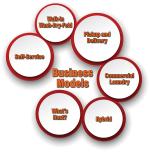
Today, owners can choose from a growing range of opportunities, including wash-dry-fold service, pickup and delivery, commercial laundry accounts, and dedicated production facilities that operate independently of a retail store.
With so many options available, the real challenge isn’t finding ways to grow — it’s determining which business model best aligns with an owner’s market, resources, long-term goals and operational strengths.
During a CLA webinar, “One Size Does Not Fit All: The Pros and Cons of Various Laundry Business Models,” operators Rob Maes of Express Laundry in Texas and Randy Roberts of Columbus Express Laundry in Ohio shared the lessons they’ve learned while expanding beyond traditional self-service operations.
Although their businesses have followed different paths, both stress that sustainable growth comes from understanding your capabilities, serving customer needs and expanding with purpose rather than pursuing every opportunity.
WHY LOGISTICS BECOMES THE REAL BUSINESS
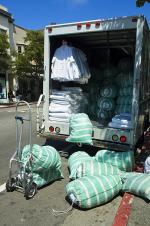
One statement frequently heard in industry circles is that pickup and delivery isn’t really a laundry business — it’s a logistics business. Both operators agreed.
Roberts identified logistics as one of the most challenging aspects of expansion into pickup and delivery.
Many operators underestimate what is required to coordinate routes, manage drivers, schedule pickups and ensure timely deliveries.
The vehicles themselves represent a significant investment. Costs include acquisition, insurance, maintenance, fuel and repairs. Hiring and training reliable drivers adds another layer of complexity.
For that reason, both operators encourage measured growth.
Maes advises against making major vehicle purchases before securing sufficient laundry service customers.
“We got the business and then we figured out how to handle it,” he says, recalling how commercial deliveries initially were handled using his wife’s minivan.
Only after demand increased did the company gradually add dedicated vehicles.
Roberts echoes that advice.
“The build is never as quick as anybody I’ve talked to expected it to be,” he says.
Entrepreneurs often assume customer growth will happen quickly. In reality, building routes takes time and persistence.
“If you think it’s going to take three weeks, it takes three months. If it’s going to take three months, it takes 12 months.”
For operators beginning to offer pickup and delivery, patience can be just as important as capital.
THE IMPORTANCE OF ROUTE DENSITY
One advantage that commercial pickup-and-delivery service offers is predictability.
Unlike residential laundry customers who may place orders sporadically, commercial clients typically generate recurring volume on consistent schedules.
That predictability allows operators to build route density and better manage production.
Maes described a system in which commercial customers are assigned scheduled pickup and delivery days. Once routes become established, owners can forecast production needs and allocate labor accordingly.
The approach helps operators avoid emergencies while improving efficiency.
Route density also tends to drive growth.
When drivers regularly visit customer locations, opportunities often arise to capture additional volume.
By contrast, operators promising rapid turnaround times without route structure may find themselves constantly reacting to customer demands rather than managing operations proactively.
Roberts intentionally avoids 24-hour turnaround commitments for many accounts.
“We’re not looking for an emergency every night,” he says.
Instead, his company focuses on predictable schedules that allow sufficient time to process laundry properly while maintaining operational control.
TECHNOLOGY CAN BE A FORCE MULTIPLIER
Although laundry remains a hands-on business, technology increasingly plays a significant role in operational efficiency.
Roberts strongly advocates automating as many processes as possible.
“The first right thing we did was select a point-of-sale system,” he says.
Without technology, route scheduling, customer management and order tracking can quickly become overwhelming.
He also highlighted investments in automated chemical-injection systems, artificial intelligence (AI) for answering phones, and production equipment designed to improve consistency and throughput.
The key, however, is implementing technology that matches operational needs.
Owners don’t necessarily need sophisticated systems on day one. Many technologies can be added as volume increases and workflows become more complex.
Maes notes that today’s operators benefit from software options that simply didn’t exist when he entered the business.
Even basic route optimization tools available through mapping platforms can improve efficiency.
Today, software can automate tasks that once required manual logs, paper records and extensive administrative effort.
STAFFING REMAINS THE BIGGEST CHALLENGE
Despite advances in technology, both operators identified labor as one of their greatest ongoing challenges. Finding, training and retaining quality employees remains difficult throughout the industry.
For Maes, the challenge often centers on hiring attendants capable of balancing multiple responsibilities.
In his stores, attendants clean facilities, assist customers and process wash-dry-fold orders simultaneously.
Success requires judgment and prioritization, and teaching employees how to prioritize effectively is critical.
When interviewing for an attendant’s position, Maes asks applicants this hypothetical question:
If you were given these three problems — a self-service customer needs help, somebody has spilled soap on the floor, and you have a drop-off order that is due in 10 minutes — which would be your priority?
“What do you think the resounding answer is?” he asks. “It’s to finish the drop-off because it has a deadline. The irony is the other two are probably more important.”
Roberts faces similar staffing challenges from a production perspective. His operation focuses heavily on throughput while maintaining quality standards.
Employees inspect items before processing, monitor quality throughout production and conduct final inspections before orders are returned to customers.
The objective isn’t simply speed.
“Our job is to put as much quality product through as quickly as we can,” Roberts says.
Achieving that balance requires employees who understand both productivity and customer expectations.
Coming in Tuesday’s conclusion: Choosing a growth strategy while understanding that success comes through service
Miss Part 1? You can read it HERE
Have a question or comment? E-mail our editor Bruce Beggs at [email protected].