DUBOIS, Wyoming — New York City art gallery Bortolami last week opened a contemporary art exhibition here at the Dubois Laundromat & Car Wash that will run through Oct. 31.
“Frogs,” by Brook Hsu and Louis Eisner, is a retelling of the ancient Greek comedy of the same name through modern paintings and cast bronze sculptures.
But why stage it in tiny, remote Dubois, population under 1,000?
“As with each artist/city project, the exhibition was developed and site chosen in close collaboration with the artists,” Bortolami states, “with the venue functioning as both a novel context for the presentation of contemporary art and an integral component of the exhibition.”
The play “Frogs,” by Aristophanes, tells the story of a “katabasis” — a descent to the mythological underworld — undertaken by Dionysus, the god of theater, to revive the late tragic playwright Euripides.
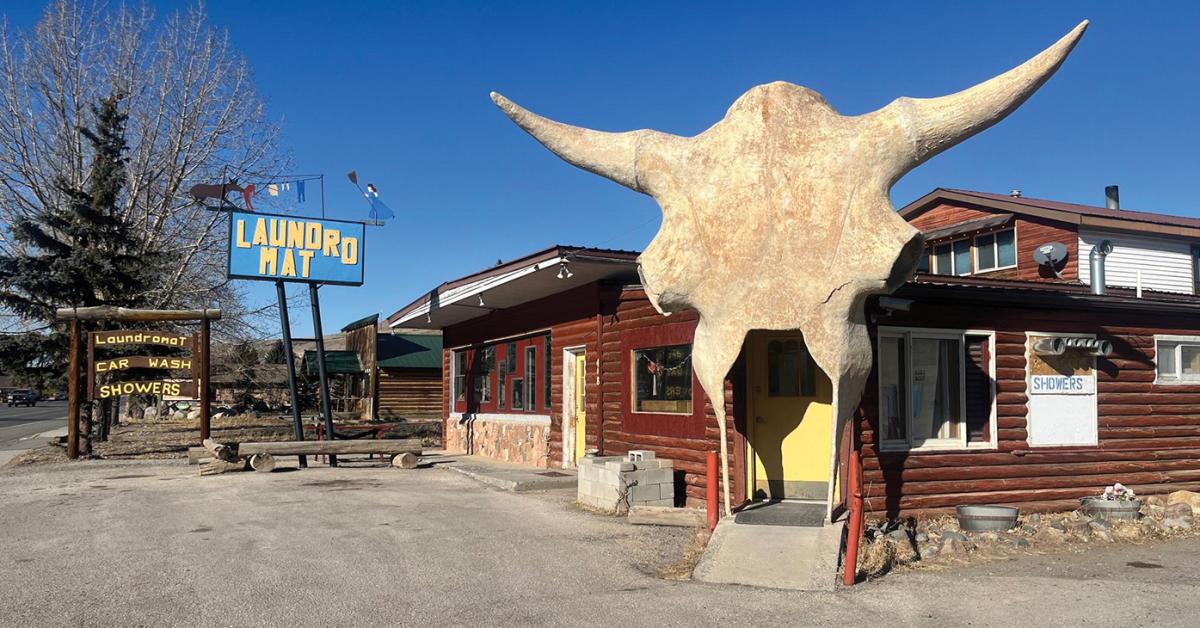
Within exhibition context, Hsu and Eisner view the laundromat’s 15-foot-tall fiberglass cow skull, a permanent fixture of its entryway created by artist and previous owner Vic Lemmon, as a metaphorical portal to the stage on which the fable comes to life.
The artworks on exhibit are rich with references to the history of art, both modern and classical, as well as 19th century American westward expansionism, Bortolami says.
Titled after the exhibition and the play, Hsu’s paintings “Frogs” reinterpret a poster for Buffalo Bill’s Congress of Rough Riders of the World, a traveling entertainment spectacle that introduced prototypical horsemen: the American cowboy, American Indian, Cossack, Mexican vaquero, Riffian Arab and South American gaucho.
Inspired by an ad depicting this international band of machos in their traditional headwear — and Buffalo Bill riding a bucking bullfrog — Hsu renders the scene anew with the riders themselves as frogs, simultaneously referencing Japanese artist Kawanabe Kyosai’s satirical print “Fashionable Battle of Frogs” (1864).
Rather than critique earlier representations of cultural difference and their inherent inequalities, Hsu uses them instead to reflect on the past, expressing painting’s ability to stir and maintain conflicting interpretations, memories, and emotions.
Meanwhile, Eisner’s cast bronze sculptures pay further tribute to the exhibition’s title and venue with frogs one almost expects to hop (buck?) off their clothing hangers, and a lizard that could at any moment scurry across the book upon which it rests — itself a cast made from a copy of Aristophanes’ “Frogs.”
RELATED: “Goin’ with Cohen: Wacky World of Wash,” May 22, 2018
Have a question or comment? E-mail our editor Bruce Beggs at [email protected].