
CINCINNATI — Often seen as a quiet, traditional small business, the laundromat industry is attracting ambitious young investors who see untapped potential in innovation, customer experience, and efficiency.
American Coin-Op interviewed a trio of dynamic entrepreneurs, each with his or her own approach to reshaping the future of self-service laundry. With unique ideas, tech-savvy strategies, and a commitment to community, they are proving that laundromats are more than just a place to wash clothes.
BALANCING LAUNDROMATS AND FINANCE
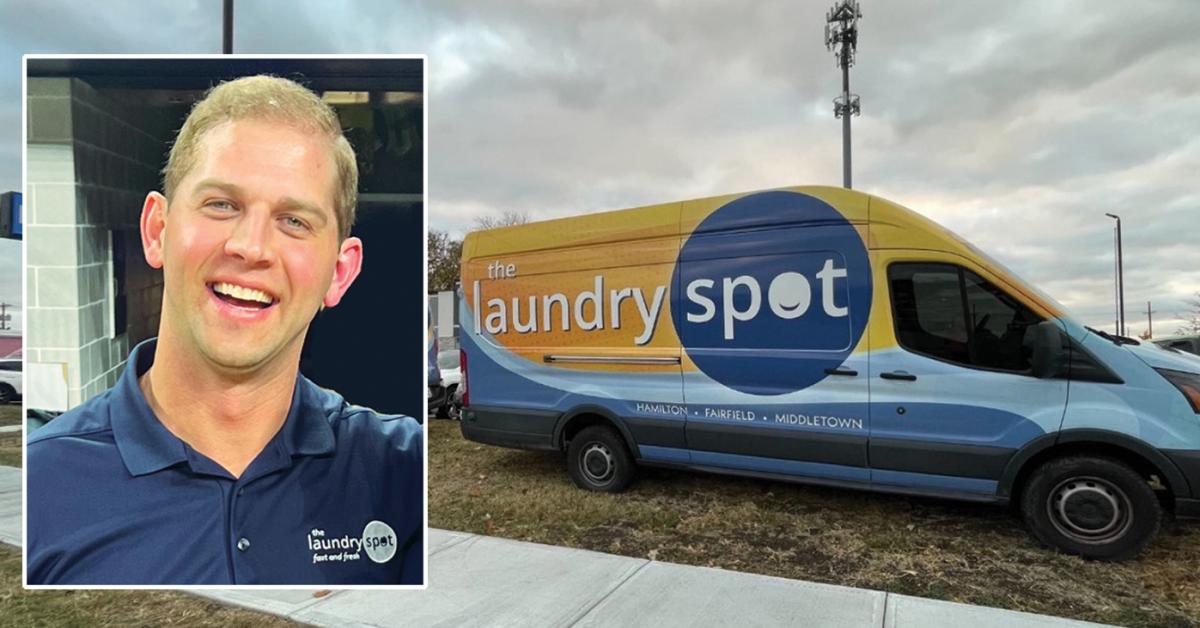
Balancing laundromats and finance is all in a day’s work for Tyler Purcell, 36. He’s co-owner of The Laundry Spot, which has four locations in the northern suburbs of Cincinnati, plus he’s a full-time financial planner for Balance Wealth.
“I say I’m a financial planner by day and laundry owner by night,” he quips.
When he began dating his now wife Sarah a decade ago, he learned her father was a laundromat owner.
“He’s a super smart guy. He was into commercial real estate, property and casualty insurance. I said, ‘OK, it must be a decent business.’”
Fast forward a few years. Purcell has married Sarah and his father-in-law approaches them and Sarah’s brother about the laundry: “I think I’ve got a good thing. Would you guys want to team up and open more of these things?”
Not having used a laundromat since college, Purcell was surprised to find the state of local stores at the time: “I could not believe how poorly run some of these operations were but there were still people there doing their laundry. … People deserve a better place to do their laundry. You come to get clean, wash your clothes. How are you having a dirty facility?”
Purcell asked to see his father-in-law’s financials: “Wow! I couldn’t believe how much he was netting on one laundromat.”
The trio agreed to come aboard. Purcell’s brother-in-law was skilled at graphic design and oversaw rebranding. Their portfolio has grown to four “Spots.”
Purcell recalls putting in a lot of time in the trenches early on.
“In the beginning, I was learning,” he says. “I knew nothing about the laundry industry. … I was having to run from my day job to go work a (laundry) shift because we couldn’t get anyone to cover. There’s pictures of me saw cutting the ground at some of our first stores. I was in it, in it six, seven, eight years ago.
“But as we grew and expanded, it was important for us to build out this kind of corporate structure, because we all have day jobs. This is a side business for all of us.”
With a GM and two assistant GMs now on the payroll, Purcell says each owner today probably spends “a few hours a week on it.” They’re contemplating their next move, whether it might be continuing to add new stores or franchising their concept. “We’re looking at all options, trying to figure out what makes the most sense.”
Purcell’s background made him ideally suited to chart The Laundry Spot’s finances.
“I was going through balance sheets and P&Ls all the time, evaluating different ways to make the business better … like a CFO-type of view on how we run our business. We run it like a big business, not like a small, local laundromat. We have bookkeepers. Our P&Ls are pristine. We track everything. You name it, I can get a report for you.”
The four attended stores “have the same operating guidelines, the same training,” Purcell says.
“When I got into this, it was when the 450-g machines, the soft mounts, were getting popular. We learned about the technology there, how much they can spin out, less dry time. We were sold. All of our stores have 450-gs. A few years ago, touchscreen equipment came out, so two of our stores have upgraded 450-g touchscreens. That offers customization and a lot of variability on wash cycles. … The technology has really accelerated the last five or so years in the laundry industry.”
Three of the four stores are between 4,000 and 4,500 square feet, while the fourth and newest covers 9,000.
“We started growing a lot of commercial business and wanted this new store to be able to handle that portion,” Purcell explains. “It’s basically double the size. We have a garage to pull the vans in. We can block off half of the self-service area to do that commercial (work) on slow days.”
Purcell believes that larger stores capable of handling commercial work beyond self-service and residential wash-dry-fold represent the future of the industry.
“I feel it’s an untapped piece of your community laundromat. You always think these big commercial companies (like Cintas and Unifirst) own that, but small-business owners like to work with other small-business owners. Our flexibility, our product, our service, a lot of times, is better than those big companies.”
Miss earlier parts of this article? You can them here: Part 1 — Part 2
Have a question or comment? E-mail our editor Bruce Beggs at [email protected].