
MILWAUKEE — Often seen as a quiet, traditional small business, the laundromat industry is attracting ambitious young investors who see untapped potential in innovation, customer experience, and efficiency.
American Coin-Op interviewed a trio of dynamic entrepreneurs, each with his or her own approach to reshaping the future of self-service laundry. With unique ideas, tech-savvy strategies, and a commitment to community, they are proving that laundromats are more than just a place to wash clothes.
‘LET’S JUST KEEP GOING’
Kelli Johnson, 27, didn’t expect the media attention The Washroom has received since she opened it in the Murray Hill neighborhood of Milwaukee. Murray Hill Quick Wash had occupied the site for many years but she changed its vibe upon taking ownership in November and renamed it. She’s done interviews with local newspapers, business journals and TV stations.
“It’s been pretty busy, almost too busy,” says Johnson. “I just started an Instagram account. I just wanted to reach out, I know people use laundromats in Milwaukee, especially college students, so that’s what I was trying to get at.”
The University of Wisconsin-Milwaukee, Marquette University, and the Milwaukee School of Engineering all have campuses nearby.
She was pursuing a degree in environmental science at the University of Wisconsin-Stephens Point when a “study abroad” visit to Kraków, Poland, inspired her business venture.
“We went to this really awesome laundromat that was a dual space, so it was a bar and also a laundromat,” she recalls. “There were attendants there who took care of the laundry. We got to hang out and got work done. I guess in my mind, I said if I were to ever have a business, it would be a laundromat that also had a dual space, specifically in an area where there are college students.”
Johnson got her degree and now works in the energy field, assisting owners of industrial buildings in saving on utilities. She says her notion of opening a laundromat was “an on-off thing for a very long time.”
At one point, she shared her concept with an investor but he chose to go a different route.
“But that’s what I think I needed, actually,” she says, “because he had me build an entire business plan, who was my competition, what do I have to work with. I put everything into that business plan and told myself I should just do it.”
She didn’t have the needed capital, so two years ago she bought and renovated a house that she has rented out. She then pulled her equity out of that house in order to buy a laundry.
Johnson called lots of laundries in Milwaukee looking for the right opportunity. Eventually, she connected with the Murray Hill Quick Wash owner, who was looking to sell.
Johnson had a branding concept in mind and wanted to fit it into a “retro vibe.” Her favorite colors: dark green, rust and gold.
“I painted the floors; there was this ugly, salmon-toned tile. I didn’t have the budget to re-tile, so I painted,” she says. “I added a mural to the wall. The walls are painted white so I can have a blank canvas.”
Many washers weren’t operational, so Johnson dove into learning what was needed to fix them. “Turns out, I had to replace quite a bit.” And slowly but surely, she’s doing just that.
She kept about a dozen original top loaders, replacing the rest with 10 new 30-pound front loaders that were installed just days after this interview. Plus, she bought six new single-pocket Huebsch dryers to complement some older working units still in place.
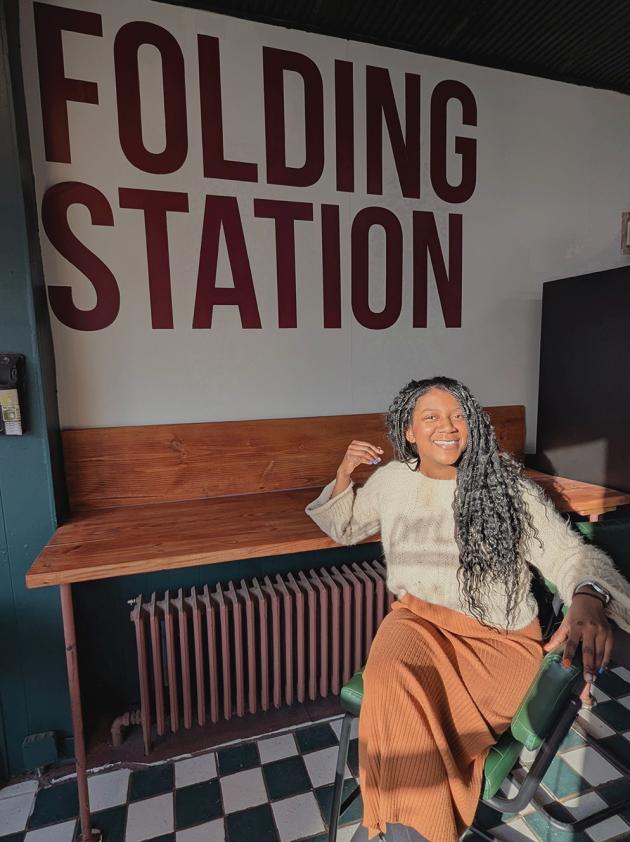
There’s a neat lending library in the back. Folding tables have been updated. Along one wall is a long countertop with high chairs. There’s free Wi-Fi, comfortable seating, and alternative music playing in the background.
“I think the interior design that I put a lot of thought into really caters to a younger crowd,” says Johnson. “It’s still not to the place where I want it to be. The walls are still pretty blank. There’s still so much I’d like to do. It’s just, with a full-time job, I just haven’t had the time or energy to dedicate to it.”
The vending machine has an eclectic mix of snacks as well as community resources targeting the younger demographics. You can find condoms, Narcan and Plan B pills beside the cookies and blondies from a local bakery.
She’s gotten some complaints about things sold there. “But I think it helps more than it hurts. That’s why I haven’t gotten rid of them.”
The Washroom only offers self-service at present.
“The space is so small, about 1,000 square feet,” Johnson says. “I have been giving thought to if I were to do a wash-and-fold business, how would that look. But that would require me to quit my job, because I think there needs to be someone managing that system, at least in the beginning. And I don’t really know if I could sacrifice my job as of right now.”
Johnson has no paid help. She’s doing it all for her unattended store right now.
“I have an investor friend who’s kind of helpful but it’s a lot of learning as I go, which is very scary … the learning curve is pretty high but nothing that I can’t tackle, nothing is out of my realm.”
After all, she bought and renovated a house herself to be able to afford the laundry in the first place.
“No one’s teaching me or telling me how to do it. A lot of times, I do something and I make a mistake. I say, ‘OK, well, don’t do that again.’ Let’s just keep going.”
In Thursday’s conclusion: Meet multi-store co-owner Tyler Purcell of Cincinnati
Miss Part 1? You can read it HERE
Have a question or comment? E-mail our editor Bruce Beggs at [email protected].