
ORLANDO, Fla. — When the doors open at a modern self-service laundry, customers may find LED lighting, digital payment options, and app-driven pickup and delivery services — conveniences unimaginable to an earlier generation of laundry owners. Yet for all the new tools, one simple truth still defines success in this industry: customers expect a clean, well-run store and a friendly human connection.
That theme resonated throughout the Clean Show 2025 educational session “From Tradition to Innovation: A Generational Shift in Laundromats,” which brought together family teams representing both seasoned veterans and up-and-coming successors.
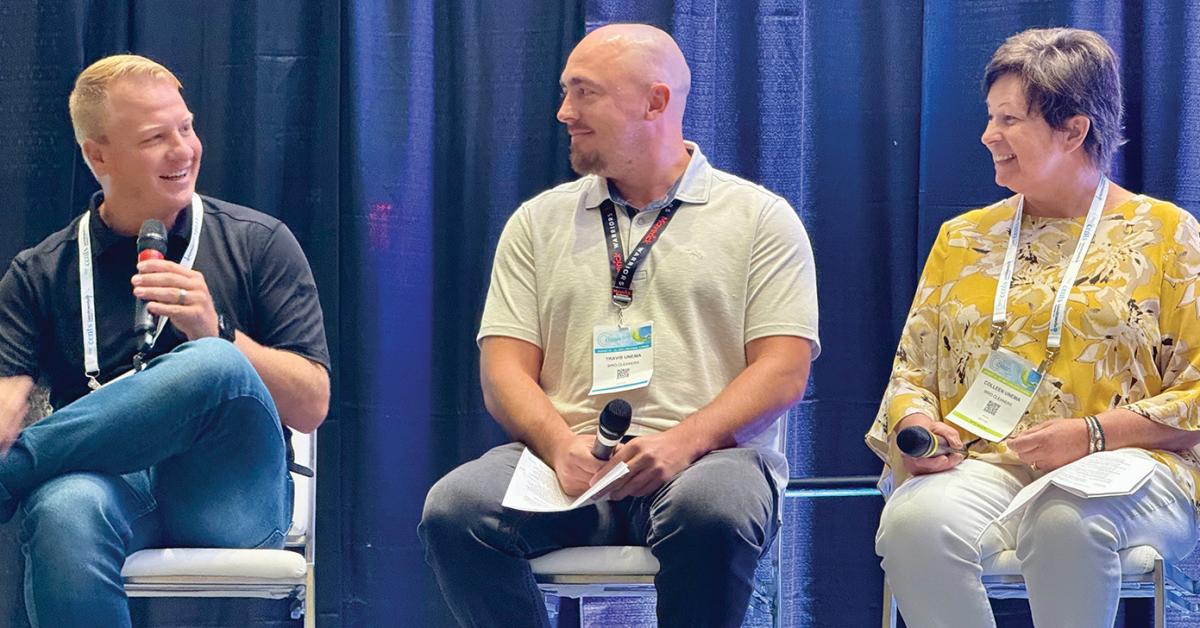
Moderated by Alaa Elbanna, owner of Bubbles aRe US in New Jersey, the panel featured Colleen and Travis Unema of Brio Laundry in Washington state; Alex and Damien Bloom of Wash Works in Massachusetts and Connecticut; and Logan Wuethrich of Ladybug Laundry in Indiana.
Each family’s story illustrated how differently — yet how compatibly — generations can approach the same business, blending legacy values with new perspectives.
In Part 1, the panel discussed how the basics still matter and that collaboration beats competition. Part 2 covered adapting to technology, marketing across generations, and customer expectations and connection. Let’s conclude:
NAVIGATING FAMILY DYNAMICS
Running a family business introduces its own challenges. There’s a need to balance respect and independence.
“I carry on (my mother’s) principles — people, planet and profit — and always give her credit for creating the business,” Travis Unema says. “Many people were customers for her for 10 years, and now they’re my customers.”
Colleen admits the transition required trust. “I wanted to sell. I wasn’t looking for a partner,” she says candidly. “I liked being the entrepreneur, the sole owner, and so when he took over, he took over.
“I wasn’t there to micromanage. I wasn’t there to say this is the right way. In my position, I wanted to step back. … My role is very different than it was. It is not in the day-to-day operations, in the hiring or the firing, things like that. Mine is the kind of the large-owner vision and listening to his vision.”
Their handoff included a three-month transition, which Travis likens to “going off to college on my own.” It was tough but necessary for growth. “No one can run a business alone,” he adds. “That’s why there’s roots, you know, community and collaboration.”
Elbanna reminds attendees to handle disagreements privately: “Your staff will recognize how you treat your partner,” he says, so never bad-mouth family in front of them. Respect must stay visible.
For Alex Bloom, whose wife is also involved in Wash Works along with son Damien, the hierarchy is looser. They don’t have assigned tasks. “We haven’t divided tasks strictly,” Alex says. “Everyone knows what needs to get done and we just do it.”
Wuethrich offered a different lesson: plan transitions early. “Know where the timeline is,” he advises. Set parameters and make it official.
His structured buyout preserved both relationship and respect. “My dad’s one of the smartest guys I know,” he says. “But I knew that we had a date, a turning point where I’d make the decisions and he’d retire.”
Older owners’ intuition is irreplaceable. Elbanna says his father could spot a bad laundromat location just by watching the parking lot. Despite this, Elbanna once ignored his advice and acquired a store that ultimately performed horribly.
“As the younger generation, we have all these tools. We have all this access to information, but there is something to be said about the wisdom that [the older generation] acquires from their experiences at life,” Elbanna says.
LOOKING AHEAD: THE NEXT ERA OF LAUNDROMATS
Asked about the industry’s future, panelists offered a mix of optimism and warning.
Alex Bloom expects continued modernization. “The business is kind of recession-proof and will be here for the long term,” he says. Upgrading rundown stores into bright, beautiful spaces sets better customer expectations. And pickup and delivery will keep expanding because convenience is king.
Son Damien agrees, joking that few of his peers even know how to do laundry — which only strengthens the case for professional services.
Colleen Unema has observed a new trend: partnered ownerships. “Two, three, or four people are forming a group and investing in laundromats,” she says. “That’s very different than it used be.”
Travis Unema stressed diversification. “My whole idea is to get multiple avenues of revenue, between dry cleaning, pressing, pickup and delivery, wash-dry-fold, retail sales,” he explains. “I’ll stick within my knowledge of that, combined with online training for employees, and build a team and solid revenue streams.”
Wuethrich delivered perhaps the most sobering perspective. “Overexposure to private equity and mass consolidation” is a huge threat, he warns. “If we don’t collaborate across the industry as independent owners who are doing more than just making money, then we’re going to be killed by private equity.”
Elbanna points to community programs through organizations like LaundryCares that demonstrate the heart of family operators. “That is what’s going to set us apart,” he says.
BRIDGING THE GAP
The panel made one truth undeniable: While generations may differ in style, pace, and comfort with technology, their goals align. They all want clean, efficient stores; loyal customers; and a sense of purpose that extends beyond profit.
For older owners, the message was to share hard-earned wisdom and plan to step aside gracefully when the time comes. For younger successors, it was to innovate boldly while honoring the values that built the industry.
In an age of automation and corporate scale, the family-run laundromat remains the heartbeat of the self-service laundry world — a place where human connection still matters, even in the era of mobile apps and data dashboards.
Miss an earlier part? You can read it here: Part 1 — Part 2
Have a question or comment? E-mail our editor Bruce Beggs at [email protected].