ORLANDO, Fla. — When the doors open at a modern self-service laundry, customers may find LED lighting, digital payment options, and app-driven pickup and delivery services — conveniences unimaginable to an earlier generation of laundry owners. Yet for all the new tools, one simple truth still defines success in this industry: customers expect a clean, well-run store and a friendly human connection.
That theme resonated throughout the Clean Show 2025 educational session “From Tradition to Innovation: A Generational Shift in Laundromats,” which brought together family teams representing both seasoned veterans and up-and-coming successors.
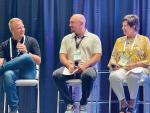
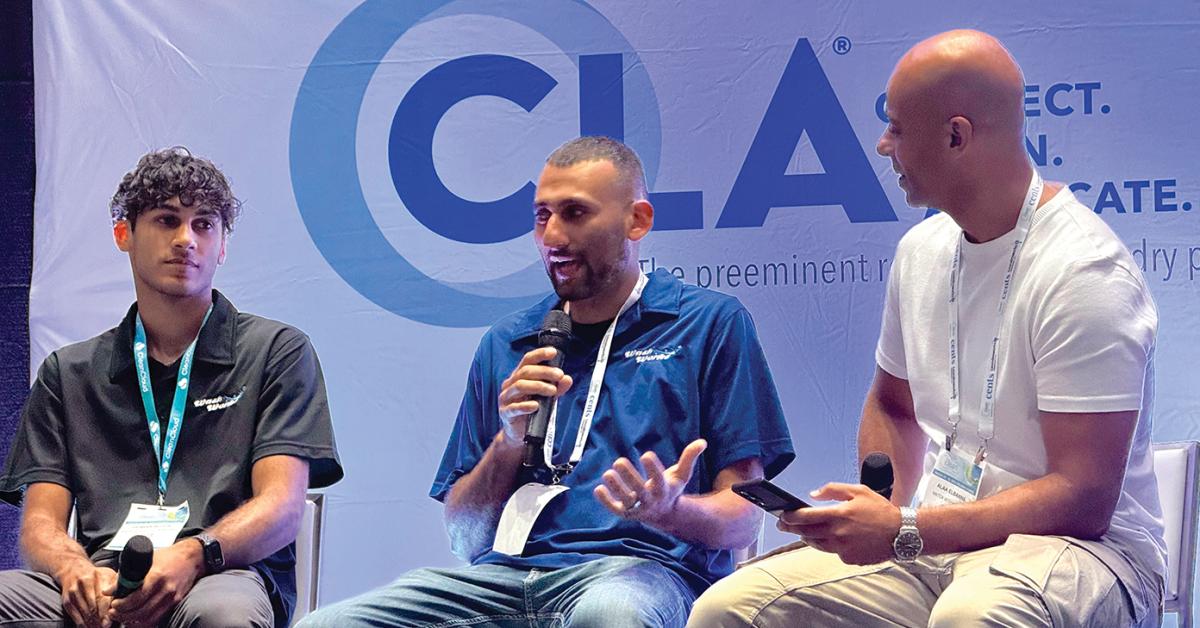
Moderated by Alaa Elbanna, owner of Bubbles aRe US in New Jersey, the panel featured Colleen and Travis Unema of Brio Laundry in Washington state; Alex and Damien Bloom of Wash Works in Massachusetts and Connecticut; and Logan Wuethrich of Ladybug Laundry in Indiana.
Each family’s story illustrated how differently — yet how compatibly — generations can approach the same business, blending legacy values with new perspectives.
In Part 1, the panel discussed how the basics still matter and that collaboration beats competition. Let’s continue:
ADAPTING TO TECHNOLOGY
When conversation turned to digital tools, the generational divide became more pronounced — but also productive.
Wuethrich says his phone is now his command center. “I can do everything I need to do using my cell phone,” he says, later adding, “It’s not so much a certain piece of tech, it’s understanding the full capabilities of the tech you’re using. So many people use tech and they use 10% of 10 different platforms.”
Travis Unema uses employee-management software that integrates scheduling, messaging, on-demand pay, and attendance tracking. “They can see their schedule and know what their training (requirements are), so all their expectations are set up for employment.”
Elbanna reminisced about “sore thumbs,” a term his maintenance man coined before machines could be programmed remotely.
For Colleen Unema, the evolution has been dramatic. “When I started teaching, the Apple IIe (computer) was new,” she laughs. “Now everything’s on my phone.” While she embraces new systems, she favors incremental testing. Her son’s approach? “Let’s try it all at once.”
That generational tension, she admits, forced her to loosen control. “(Travis) took over and within a week, all my three-ring binders full of SOPs [standard operating procedures] are in a box.”
Travis emphasizes that technology adoption only works with proper training: “It’s a skill,” he says. “Have a plan to train your team and your customers so it’s clear and deliberate.”
Elbanna urges older owners to move at their own pace — but to move. His father once resisted putting in a credit card system until he saw sales jump 40%. “Do it at a pace you’re comfortable with but implement it in a way where you make sure there is proper training and everybody is comfortable with it.”
MARKETING ACROSS GENERATIONS
Marketing offers another contrast between old and new approaches.
Travis Unema continues some of his mother’s analog efforts. “Radio ads are hard to track but people who come in always talk about it,” he says. “Just because I can’t see what the Google analytics are doesn’t mean I’m going to remove it.”
Colleen noted that their business goals differed by phase. When she opened, every new customer was expensive to acquire but she had to build a customer base. Travis, coming in at year 10 of Brio, focused on retention but honored his mother’s foundational work.
“I liked his approach: ‘OK, let’s look at what you’ve been doing and what’s been working and add to it.’”
Today, she marvels at digital reach, where five Facebook posts a day can cascade to TikTok and Flipboard automatically. “The power at their fingertips is phenomenal and exciting.”
One change Travis implemented was a point of sale system with the ability to automatically message customers, whether new, returning or lapsed.
Alex Bloom admits to being “a Facebook guy” reluctant to embrace TikTok until younger staff convinced him. “Now we’re trying to grow it,” he says.
Damien Bloom sees short-form content as the future. “That’s what’s engaging,” he says. “It’s where marketing is going.”
Even Elbanna found himself humbled by generational speed, needing 45 minutes to create a post. “My 17-year-old niece could do it in 30 seconds.” Sometimes, he concludes, it’s best to hire or partner with someone who’s efficient with those tools.
CUSTOMER EXPECTATIONS AND CONNECTION
Asked how customer expectations have changed, Wuethrich responds thoughtfully: “What’s never changed through the history of time is human connection.” Customers want clean, friendly, and an experience. “Generationally, we’re more disconnected than ever on an interpersonal level.”
Travis Unema drew parallels between laundry delivery and e-commerce. “Who here has used Amazon or FedEx?” he asks rhetorically. Customers expect tracking and communication. If you add a personal touch — a phone call, a face — you exceed expectations.
Online reviews have heightened accountability, Elbanna adds. “When I have a ‘You got a Google review’ notification pop up on my phone, I lose two years off my life,” he jokes. But customer feedback keeps everyone sharp. “I think it’s important to embrace that.”
Coming in Wednesday’s conclusion: Navigating family dynamics and looking ahead to the next era of laundromats
Miss Part 1? You can read it HERE
Have a question or comment? E-mail our editor Bruce Beggs at [email protected].