ORLANDO, Fla. — When the doors open at a modern self-service laundry, customers may find LED lighting, digital payment options, and app-driven pickup and delivery services — conveniences unimaginable to an earlier generation of laundry owners. Yet for all the new tools, one simple truth still defines success in this industry: customers expect a clean, well-run store and a friendly human connection.
That theme resonated throughout the Clean Show 2025 educational session “From Tradition to Innovation: A Generational Shift in Laundromats,” which brought together family teams representing both seasoned veterans and up-and-coming successors.
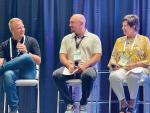
Moderated by Alaa Elbanna, owner of Bubbles aRe US in New Jersey, the panel featured Colleen and Travis Unema of Brio Laundry in Washington state; Alex and Damien Bloom of Wash Works in Massachusetts and Connecticut; and Logan Wuethrich of Ladybug Laundry in Indiana.
Each family’s story illustrated how differently — yet how compatibly — generations can approach the same business, blending legacy values with new perspectives.
DIFFERENT PATHS, SAME MISSION
Elbanna opened with his own story: he entered the laundry business more than two decades ago alongside his father, discovering through years of trial and teamwork that multi-generation relationships can be challenging, but “we came out of it stronger.”
That set the stage for introductions.
Alex Bloom, who co-founded Wash Works just two and a half years ago, described a true start-up venture shared with his 20-year-old son, Damien. “We’re three stores strong … and really a family business,” he says.
Colleen Unema, a former teacher, launched Brio Laundry in 2012 as a second career. She never planned for it to become a family enterprise. Her son Travis, then serving in the Coast Guard, surprised her when he bought a 15% stake and later acquired the business outright in 2022.
Wuethrich, whose family’s Ladybug Laundry chain now operates a dozen locations, grew up with his father treating laundromats as a “side gig” alongside farming and real estate. Logan worked with him well for a few years before deciding, as he put it, “I gotta buy you out and you gotta go retire.”
For all their differences — starting from scratch, taking over from a parent, or buying out a mentor — each participant underscored that family and respect are foundational in the laundry business.
THE BASICS STILL MATTER
Asked what hasn’t changed over time, Colleen Unema doesn’t hesitate: “Clean. If you look at reviews from the day I opened to yesterday — clean, functional machines. It’s not rocket science.”
Elbanna agrees: “Stick to the basics. Make sure when somebody walks into your laundry, it’s clean, machines are working, everything is the way it should be and everything else will fall in place.”
That first impression, the panel agreed, remains timeless. A spotless store, good lighting, and reliable machines create the trust that no marketing campaign can buy.
COLLABORATION BEATS COMPETITION
When Elbanna asked Wuethrich what outdated practice he felt compelled to abandon, the Indiana operator pointed to what he called “weird overprotection.”
“Everybody’s like, ‘This is my territory and you stay out of it,’” he says. “I’ve found that the more money somebody else makes, I make, too.”
Ladybug Laundry collaborates with other laundromat owners to bulk-buy soap directly from Procter & Gamble by the semi load. “I’ll warehouse it and you come pick it up,” Wuethrich explains. “I grow because of my collaboration with other people.”
“That’s a solid piece of advice for everyone here, whether you’re starting out or you’ve been in the industry — collaborate,” Elbanna agrees. “It’s absolutely essential.”
BALANCING TECH AND THE HUMAN TOUCH
Panelists expressed enthusiasm for technology but also caution. Colleen Unema warned that operators can become entranced with their data. “We’ve got so much information — machine usage, Google Ads, Facebook analytics — that we can lose sight of the fact that these are people walking into our stores,” she says. “They’re real. It’s not a transaction. It’s a relationship.”
Her comment struck a chord with Elbanna, who recalled how his father greeted families, bought candy for their children, and called regulars by name. “We, as the younger generation, get caught behind the screen,” he says. “We get caught looking at our data, analyzing everything, and we forget about the people who actually make our businesses thrive.”
Wuethrich echoed that sentiment but from an operational angle. “I hate outsourcing everything we do,” he says. “I’ll take poor-quality insourcing than better-quality outsourcing because I want to give people jobs. I want to teach them, I want to train them (and help them build a career). You miss that when you’re just behind the screen or chasing this thing or that.”
Alex Bloom notes that presence matters and says he tries to hang out at his stores when able. “I’ll just go over there and talk to the customers, hang out, and it helps bring them back.”
Damien Bloom does the same: “(The staff) never saw that sort of interaction between the former owner and the customer. So it’s a new face, a new thing to see.”
“If you’re not present in your laundromat, if you’re not engaging with customers, with your staff, you’re not going to set yourself apart from the competition,” Elbanna says.
Part 2 arrives on Tuesday, when the panel discusses adapting to technology, marketing across generations, and customer expectations today

Have a question or comment? E-mail our editor Bruce Beggs at [email protected].