HOUSTON — When you step into one of Rob Maes’ laundromats in this area, the first thing you may notice — aside from the hum of dryers — is that the space feels comfortable, even in the summer heat. That’s no accident.
For Maes, who has been in this business for 16 years and currently serves as president of CLA (formerly the Coin Laundry Association), HVAC — heating, ventilation and air conditioning — is more than just background equipment. It’s a critical piece of the customer experience and a misunderstood aspect of store operation.
“I’m not a technical guy,” Maes admits. “Everything I’ve learned is by hook or by crook, and by talking to a lot of other good people.”
Lessons from peers like Jeff Wagner, a San Antonio multi-store owner with an HVAC license, have shaped Maes’ approach to keeping his stores cool, efficient, and inviting.
LAUNDROMATS AREN’T LIKE OTHER SPACES
HVAC in a laundry setting is different from HVAC in most other commercial buildings. The main reason? Heat from the dryers.
“Treat your dryer doors or windows like another window in the building,” Maes says. “Most HVAC guys calculate heat load from window exposure but forget about the dryers.” Even modern dryers with insulated doors give off significant heat, and without accounting for it, systems can end up undersized.
Makeup air — fresh, outside air introduced into a building to replace air that’s been exhausted through ventilation — is another commonly overlooked factor.
“If the dryers don’t have enough makeup air from outside, they’re going to pull it from inside,” Maes explains. “If you’re running air conditioning, that means your dryers are literally using your conditioned air.” That not only wastes energy but also forces HVAC units to work harder.
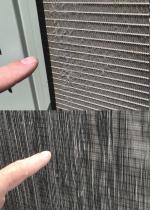
Then there’s lint. For operators like Maes who vent dryers through the roof, lint inevitably makes its way into HVAC coils, reducing efficiency. His rule of thumb: add about 20% more cooling capacity to account for clogged coils. But he also cautions against oversizing. Too much tonnage leads to short cycling, which wears out compressors and capacitors.
COMMON PROBLEMS AND HOW TO AVOID THEM
Capacity issues top the list of HVAC headaches in laundromats. Undersized systems run constantly, sometimes burning out condenser fan motors and wearing out components faster.
Coil cleaning is another ongoing battle. Maes outfits his rooftops with hose bibs so staff can rinse coils without hauling equipment up a ladder.
He also recommends choosing units with microchannel coils, which have sturdier fins that can withstand high-pressure rinsing without damage.
BUILDING A MAINTENANCE PLAN
For Maes, preventive maintenance starts with testing makeup air. He credits fellow CLA member Ken Barrett from Alabama with this simple test: after closing the store, run all dryers, open the front door, and see if air rushes in. If it does, you’re short on makeup air and should consider adding an intake.
Filter changes are another priority. Using an infrared thermometer gun, Maes checks the temperature of return air and of the nearest supply vent. “If the intake is 80 degrees and the supply is 65, you’ve got a 15-degree differential,” he says. “When that drops, it’s time to change the filters.” His staff marks the date directly on the return grille with masking tape to keep the schedule consistent.
Coil cleaning frequency can vary store to store. In his early days, Maes cleaned every three weeks in summer. With larger units and extra tonnage, twice a year is enough. He advises keeping dryer vents far from condenser coils to lessen lint accumulation.
In Tuesday’s conclusion: Lease expectations and when to repair or replace your HVAC

Have a question or comment? E-mail our editor Bruce Beggs at [email protected].